|
For two weeks, my film 农家乐 Peasant Family Happiness, can be watched online as a part of Cultural Anthropology's Screening Room (Visual and New Media Reviews). The feature also includes an extended interview, in which I talk about my fieldwork on ethnic tourism in rural China, and how I see filmmaking as a part of my ethnographic research and anthropological scholarship. Thanks go to Patricia Alvarez and Berkeley Media for making this happen -- it was a really productive opportunity for me to reflect on how ethnographic filmmaking as a process can inform, and ideally deepen, one's analysis and insights from fieldwork. To watch the film and read the interview, CLICK HERE.  The new year has started with a rush! At Emory, I'm excited to be teaching my China anthropology course again, which has been updated with some new materials and will feature a guest lecture by two Chinese scholar-filmmakers from Yunnan in April. I'm also running a new graduate seminar, "Heritage and Power" with a great, multi-disciplinary group of students from across the university.
Moreover, I've just settled the dates for a number of public talks, seminars, and film screenings over the course of the spring in Montreal, Los Angeles, and Seattle. The dates and titles are below, and further details will follow: February 15, 2016 Digital Ethnography and Community Media Graduate Seminar, Concordia University February 16, 2016 Buffalo, Wrangler, Videographer: Vernacular Media and the Afterlives of Bullfights in Southwest China Public Talk, Global Emergent Media Lab, Concordia University March 5, 2016 农家乐 Peasant Family Happiness Film screening and discussion, USC-RAI Ethnographic Film Festival in Los Angeles, Center for Visual Anthropology, University of Southern California (USC) March 7, 2016 These Days, These Homes: The Process of a Film-in-Progress Graduate Seminar, Center for Visual Anthropology, USC March 11-25, 2016 Cultural Anthropology Screening Room (Online) Review and filmmaker Q&A with online access to my film, 农家乐 Peasant Family Happiness April 2, 2016 Collaboration and Power: The Politics of Community Media in China and Taiwan Roundtable discussion, Association for Asian Studies Annual Conference, Seattle April 4, 2016 Documenting Development in China: Community Media in Tibetan Qinghai Screenings and discussion of community media projects from Qinghai, China, Center for Chinese Studies, UCLA April 5, 2016 From Our Eyes: Community Media and Visual Ethnography in China Screenings and discussion, East Asian Studies Center and the Department of Anthropology, USC May 19, 2016 All Together Now: Ethnic Crowds and Vernacular Media in 'Minority' China Culture, Power, and Social Change Seminar, sponsored by Anthropology and the Center for Chinese Studies, UCLA June 19-22, 2016 Participatory Modernity: Vernacular Media in Ethnic China Paper presentation in a panel, "From Whose Eyes, In Whose Name? Interrogating Rural Media, Anthropological Knowledge, and Ethnographic Expertise in China and Taiwan," accepted for the 2016 Society for East Asian Anthropology Conference in Hong Kong, Chinese University of Hong Kong A new review of my film, 农家乐 Peasant Family Happiness, has just been published online in Pacific Affairs! Written by Tenzin Jinba, Professor of Anthropology at Lanzhou University (Gansu, China) and author of In the Land of the Eastern Queendom: The Politics of Gender and Ethnicity on the Sino-Tibetan Border, he starts his review by noting the questions immediately brought to mind by the film's title: "We may wonder: What does visiting peasant homes have to do with happiness? Are peasant hosts happy, too?" His own research (which I assigned last year in my course on ethnicity and nationalism in East Asia) explores many phenomena experienced and confronted by ethnic minority communities in Sichuan Province due to tourism development and modernization that were very similar to what I have observed and analyzed in Guizhou and Guangxi. I'm grateful for his expert attention to the questions raised by my film regarding ethnic identity in China, development processes, social transformation, and individual ambitions in rural communities. These are issues that are only deepening in meaning and political potential in light of China's poverty alleviation campaign that is being touted as part of the next Five Year Plan. As I continue to visit Ping'an and Upper Jidao nowadays, I'm keenly aware of how tourism is both definitely "here to stay" in both places and how changes in the domestic and global tourism industries, combined with shifting opportunities for village residents, are creating new challenges and possibilities for village social relations and imaginations of what "peasant family happiness" might entail in the future. 
At the 2016 Association for Asian Studies meeting in Seattle, I will be a part of a roundtable discussion on Aboriginal and community media in China and Taiwan. I'm very excited that this has been accepted because it will provide an opportunity for Asia scholars to view new contemporary documentary films by ethnic minority filmmakers from both China and Taiwan. The event will feature visual anthropologists, film scholars, and media practitioners from Yunnan University, Yunnan Arts Institute, and Tainan National University of the Arts, and we intend to leave plenty of time for discussion and dialogue with audience members.
I will post details on the films to be shown when they are confirmed, but here is the panel abstract and the date/time. Hope to see many scholars of media, community development, and ethnic minority politics in Asia there! Collaboration and Power: The Politics of Community Media in China and Taiwan Saturday April 2, 3-5 p.m. Washington State Convention Center, Room 615 Seattle, WA Session Abstract: This roundtable critically engages with the thorny questions of power, agency, subjectivity, and ownership that underlie contemporary community media projects. Our collective goal is to develop new approaches to understanding the socio-political contributions and consequences of community media in China and Taiwan. Prominent examples from China include the “China Villager Documentary Project” initiated by Wu Wenguang, as well as numerous projects in ethnic minority regions of Yunnan spearheaded by academics and development organizations. In Taiwan, community media has played a significant role in indigenous, labor, and other social-political movements for decades. Our session will begin with excerpts of recent documentaries from Tibetan communities in China and indigenous communities in Taiwan. These films are produced by first-time filmmakers through participatory video workshops, and the excerpts will be followed by brief comments from the discussants and a substantial period of open dialogue. Notions of collaboration, participation, engagement, and empowerment are often taken-for-granted as positive features of community media production, and we aim to unpack such prevailing assumptions by analyzing the effects of community media within the context-specific conditions of contemporary China and Taiwan. Can these films reflect or embody new social relationships and subject positions for rural, minority people in China and Taiwan? How does the emphasis on collaboration and participation in community media reinforce and reimagine existing power relations? What forms of empowerment and/or agency are possible, and what desires or possibilities might be overlooked or overshadowed in these projects? Anthropological filmmakers Chen Xueli and Li Xin, from China, will speak to shifting power dynamics between rural and urban Chinese in their experience as trainers in participatory video workshops as well as to the subjectivity of the “native” filmmaker. Film scholars Ray Jiing and Tony Tsai will reflect upon their work with community media programs in Taiwan and on the archiving, preservation, and future of these documentaries. Jenny Chio, anthropologist and filmmaker, will discuss the role of media in rural development and the idea of “participation” in neoliberal strategies of self-governance. Together, we will foster more critical perspectives on the entanglements of power, collaboration, and media production in marginalized communities today.  The American Anthropological Association Annual Meeting is about to begin in Denver, and I'm really looking forward to my panel this year which looks at the relations of power evoked and enabled by images of crowds. Our papers, on crowds in Turkey, China, Bangladesh, and Indonesia, will think through the politics of authority, authenticity, and sincerity embedded in photographs of crowds. My talk juxtaposes news photographs of ethnic minority delegates attending national political meetings in Beijing against amateur, locally-made videos of rural Miao festivals in which crowds of ethnic Miao people feature prominently to explore how visual imagery informs ethnic politics and subjectivities in contemporary China.
We hope that these panel will prompt conversations on the significance of crowds and the workings of photographic representation in understanding the social and political power of mass gatherings. Details on the panel are below: THE CROWDED FIELD: PHOTOGRAPHING MASSES, VISUALIZING POWER Organized by Jenny Chio and Zeynep Gürsel Saturday, November 21, 8-9:45 a.m. Colorado Convention Center Room 111 Denver, CO Panel Abstract:If, as Benedict Anderson has convinced us, the rise of nationalism and the modern nation-state was spurred by the circulation of printed mass media that allowed individuals to imagine themselves as part of a greater community of like-minded citizens, what happens when communities are literally imaged, and symbolically imagined, through pictures and photographs? Crowds alternatively signal both experiences of authentic communitas and unruly disorder. Moreover, images of crowds, from rallies to protests to political assemblies, are unsettling, ambivalent indexes of political will, grassroots participation, authoritarian state power, and collective belonging. In this way, photographs of crowds simultaneously articulate and affirm the recognition of social collectivities, moving quickly from the particularity of the crowd itself, as a temporary, specific gathering of individuals, towards generalities of groups, types, and mass publics. Such photographs, and the imaginations that enliven their salience, thus encompass a multivalent site for assertions of political authority, social belonging, and newly potentiated collectivities. To examine what photographs of crowds actually do – politically, socially, culturally – this panel explores the functions of power and imagination of crowds when they are visualized. Drawing on diverse political contexts, we explore how the making of a particular image of a crowd into an icon-index of an imagined community or public is achieved through photography and visual technologies. Across our papers, we ask: How is the crowd imaged, in what forms, and for what purposes? In what spaces and forms do such images appear and circulate? Furthermore, how is a particular reading of an image of a crowd secured or unmoored as it circulates? Can a state ever create an authentic image of the nation, and what happens when an affective term such as sincerity is attributed to the collective, rather than located at the scale of the individual? What might be the politics of visibility when we consider the dialectical movements between anonymity and authority in photographs of crowds? We address these questions through ethnographic analyses of the visual representation of crowds in Turkey, China, Bangladesh and Indonesia. To begin, Gürsel explores how a state might claim and contextualize the sincerity and authenticity of the crowd, analyzing Turkey’s 2013 “National Will Rally” organized by then President Erdogan and state claims for a sincere photograph of the Turkish nation. Chio’s paper considers how ethnic minority bodies, individual and collective, are imagined in the body politic of China, from individual ethnic delegates at national assemblies to the collective ethnic crowd in local, rural video recordings. The social ambivalence of crowds as an analytic is further explored in Chowdhury’s paper on political protests against the war crimes tribunal in Bangladesh. Strassler’s comparison of crowd images and crowd-sourcing in the recent Indonesian elections draws together the themes of sincerity, authenticity, and the truth-value of photographs that inform the panel as a whole. Taken together, our aim is to build a theoretically robust understanding of the relationship between the crowd, political imaginaries, and state authority. Another review of my book is just out, this time in The China Quarterly! Written by John Donaldson (Singapore Management U), a political scientist who has written extensively on rural development, poverty reduction, and tourism in China, he offers a thorough and informed take on my analysis of how mobility and visuality constitute the "work" of tourism for village residents. Here's an extended excerpt from the review (click here for a preview of it online):
"Tourism is a complicated business, particularly if you are a villager in a poor, rural minority area of China. Jenny Chio's recent work focuses on the nuanced social impact of tourism, refreshingly adopting a 'backstage' point of view from which to examine rural tourism. As leaders of minority villages tussle with officials, tourists and even each other in an attempt to get 'doing tourism' right, Chio focuses on the effects this has on culture, power, identity, and ethnicities. Chio utilizes to good effect the lenses of scene and visuality (the need to look appropriate to a tourist), as well as movement and mobility, to analyse dilemmas confronting rural residents. The result if a satisfyingly insightful and convincing account of the stunningly complex landscape of tourism in rural China. Of the many strengths of this research, two are particularly pronounced. First, the volume includes exceptionally rich research based on Chio's extensive fieldwork in and beyond two villages. This unusual penetration into the world of tourism allows Chio to compare the impact of developing tourism sites in two unique, yet comparable, rural villages....Chio is a vivid writer who uses her extensive fieldwork and visual eye effectively. Second as an outsider not to rural tourism but to the visual anthropological lens that Chio brings, I found her use of two conceptual tools -- scene/visuality and movement/mobility -- especially effective in understanding these two villages." Donaldson also notes at the end of his review that my book should speak to the broader literature and be more clear in how I am contributing new perspectives and analytical findings to existing work on ethnicity, tourism, and social change. This is a critique that I take seriously and that I am trying to address in my current writing projects. As I have gained some distance from the book itself, combined with return visits to both Upper Jidao and Ping'an over the last years, I am even more convinced of the importance of studying tourism as a form of work and of critically unpacking the politics of visual appearances in order to understand the forces of power, desire, imagination, and obligation that inform decisions to change (or maintain) the "look" of a place and of people. The third review of my book has just been published in the journal Anthropological Quarterly, and I'm so pleased to with how Noel Salazar (U Leuven) critically engages with my work. Given Salazar's own expertise in mobility and tourism studies (his book has been an important contribution to understanding tourism labor in a globalizing industry of networks and desires), it's really exciting to see how he pushes the broader connections and comparisons that my research can, and should, create for future projects, especially, as Salazar notes, given how invested the Chinese state has become in international cultural heritage projects and recognition (such as UNESCO site designation). This was the focus of the workshop on cultural heritage politics in China that I attended in Lund, Sweden, in June and a key aspect of my new project on rural documentary media production and circulation. 
Travis Klingberg (U Colorado Boulder) has written an insightful review of my book, A Landscape of Travel, for the journal Pacific Affairs. In his review, he notes how my book extends and updates much of the earlier scholarship on ethnicity and tourism in China, as well as presenting new arguments on the intersections of mobility and development in rural China. Klingberg writes, "In highlighting the role of migrant subjectivities and labor, Chio has at the same time helped clarify the relationship between migration and tourism in China. The rediscovery of rural and remote China by urban Chinese has been a significant social and political change over the past two decades in China. This is a question that I have pursued in my own work. But mobilities of leisure and labour don’t map cleanly onto the schematic movement of urban tourists to rural China and rural labourers to urban China, and A Landscape of Travel is a valuable study of how closely related these mobilities are." Additionally, he also points out important comparative, future work that needs to be done on tourism in China -- in non-ethnic minority regions, for example, and also in the discursive deployment of "green" urbanization project or "ruralizing" urban spaces.
A preliminary version of the review is now available online and will be in the print version of the journal in a future issue. A PDF of the online version is also available here to download. I'm grateful for the time and attention to my work by Klingberg, and of course it's exciting to see my work being situated more deeply in the (relatively) small field of China tourism studies as well as across disciplinary perspectives. 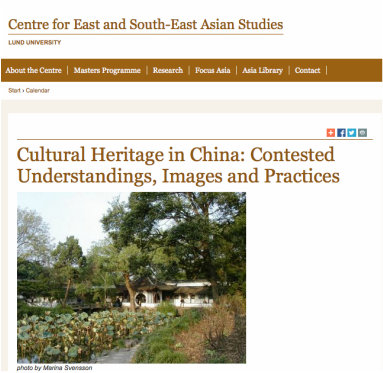 In a few weeks, I'm headed to Lund University, Sweden, for a conference on cultural heritage in contemporary China, organized by Marina Svensson at Lund University. I'm contributing a paper on bullfighting in Guizhou (and Yunnan) to this event, and it's a challenge for me to think about this part of my research in the context of cultural heritage discourses as they circulate in and through China today. Clearly bullfighting has become emblematic of certain communities in rural ethnic China, and there is a lot of pride -- and money -- invested in promoting bullfighting as a unique, local practice. How these fights, as planned events and as moments of chaotic pleasure and entertainment for the audiences (as well as income for the organizers and owners), speak to subjective senses of ethnic difference and communitas, as well as to social-structural ambitions for recognition and rewards in China's ethnic tourism industry will be the focus of my presentation.
For a few photos of bull-fighting stadiums and other related phenomena, see my post from July 2014 . 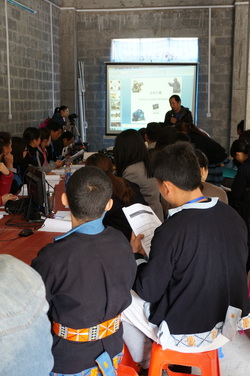 Participation in and Observations on Community Media Training This past March, I spent three weeks in Guangxi, attending and helping out with a community media training workshop. The program was collaboratively organized by a cultural heritage group based in Kunming that has extensive experience in rural video documentary and participatory media training, and a local Baiku Yao cultural heritage preservation group based in Lihu. It was my first time working directly with students and workshop participants, assisting them with the basics of field interviews and recording, documentary research, and editing on the fly. I was amazed at how dedicated all of the participants were and even more so by the fact that every group managed to complete a 20-30 minute long documentary in just 10 days. This experience also gave me much greater insight into the values and politics of community media, especially when coupled with broader desires (and financial support) for cultural heritage preservation, rural development, and individual ambitions. There is a very active eco-museum, supported by the regional government, in this area too that has helped spur local recognition of the usefulness of digital media in cultural heritage work. 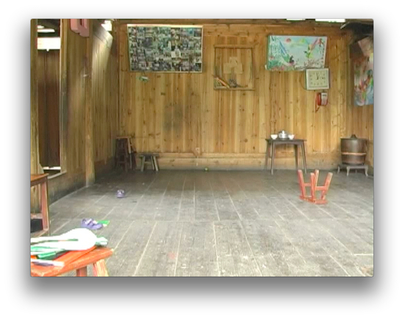 These Days, These Homes (work in progress)
Recently I've been thinking a lot about the video footage I shot over the past (nearly ten) years, and I've decided it's time to revisit this material and to try to create something new out of this "old" stuff. As I review the footage, I realize that part of what is so important, and interesting, about archival material (even if it's an archive of my own material) is precisely that with the passing of time and the changing of lives, I am seeing and discovering new meanings to this footage. I'm now starting a new film project, currently titled These Days, These Homes, that will draw on existing footage and some new video I plan to shoot over the next year. This film will focus on the stories of two women who have become important interlocutors and friends, and I hope this film will be as much a presentation of research arguments as it is a representation of our personal relationships and my gratefulness to them. I recently discussed this work in progress at the conference, Poetics & Politics: A Documentary Research Symposium at UC Santa Cruz. There, the conversations between a mix of makers and scholars from a range of disciplines pushed me to think about my new film in different directions, both formally and also socially as a means of research engagement and collaboration. |
|||||