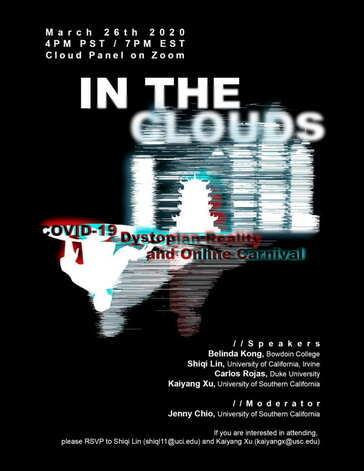
 In March 2020, I was a part of a lively online panel on COVID-19 and online sociality, organized by Ph.D. students Kaiyang Xu (USC) and Shiqi Lin (UC Irvine). As the organizers explain,
<<Drawing inspiration from “cloud clubbing,” a creative practice engaged by self-quarantined Chinese web users during the pandemic, this “cloud panel” was an experimental endeavor to discuss digital media, societal fears, and the responsibility of humanities scholars in a time of crisis. The panel brought together scholars working on biopolitics, media studies, video ethnography, urban studies, diaspora studies, and Chinese cultural studies to discuss the sources of pandemic anxieties; humor, care and intimacy animated by creative uses of social media; and the implications of social media in border-crossing. As the spread of the pandemic coincided with a transitional period of remote teaching in academia, the panel was also set up as a space for exploring alternative modes of intellectual collaboration during the pandemic.>> The transcript of the panel, featuring short essays and our Q&A with Kaiyang, Shiqi, Belinda Kong (Bowdoin) and Carlos Rojas (Duke), is now published online by the MCLC Resource Center. It's been a very long time since my last post! Here are some highlights from the past year: **My ethnography of tourism and rural social change in ethnic China, A Landscape of Travel: The Work of Tourism in Rural Ethnic China, is now open access, thanks to UW Press in collaboration with Manifold. You can read the entire book online, along with all of the books in the Studies on Ethnic Groups in China. **In 2019, I published an article on the politics of bodies, crowds, and festivals in Miao vernacular media in the journal Current Anthropology. This publication includes five scholarly commentaries by anthropologists working in China and media studies, as well as my response to their ideas and critiques. **I was invited to write a commentary on the Oscar-nominated documentary, American Factory, for Docalogue.com, a website devoted to generating conversations about contemporary documentary film. Feel free to join the dialogue on labor, culture, and globalization through the site. 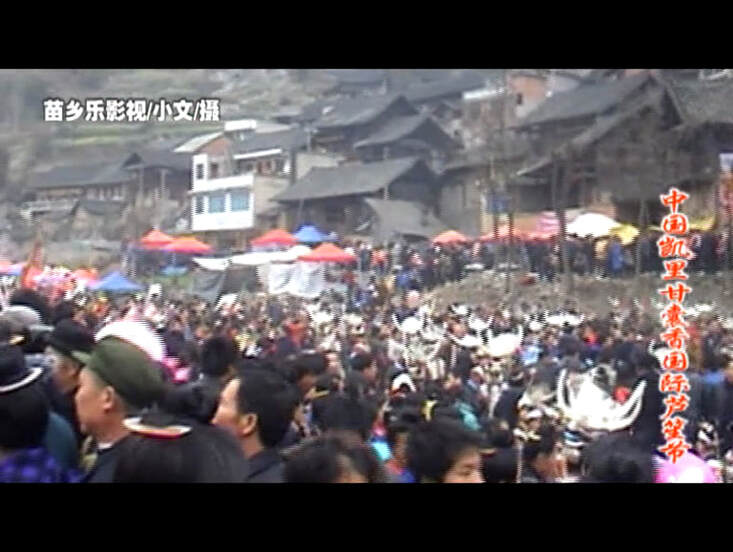 The festival crowd. Video still from the DVD Gan'nangxiang, by videographer Xiao Wen. The festival crowd. Video still from the DVD Gan'nangxiang, by videographer Xiao Wen. 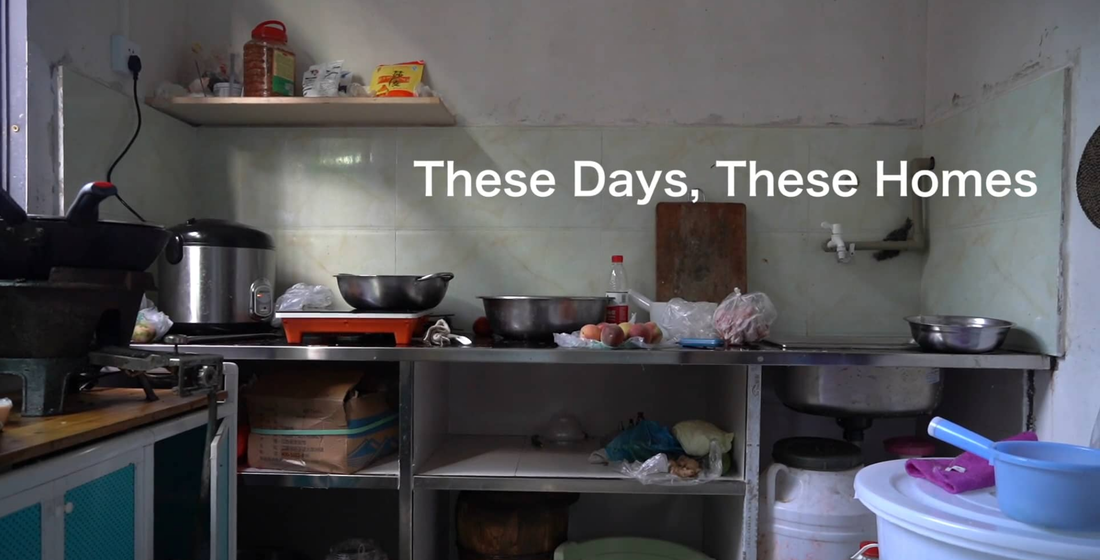 I've just released a "preview" of my work-in-progress second film, These Days, These Homes! With support from the Fejos Postdoctoral Fellowship (awarded by the Wenner-Gren Foundation), I've been working on the film all year and hope to have it finished in 2019. For a description of what I've been doing and what's coming next for the film, see my blog post on the Wenner-Gren website.
As of August 2018, I'm now based at the University of Southern California, as Visiting Associate Professor of East Asian Languages and Cultures. Moving from Atlanta to Los Angeles took up most of the summer, but now the semester has begun at USC and it's full steam ahead. I'm excited to be teaching a First-Year Seminar titled "Nation, Culture, and Power in East Asia" as well as a graduate seminar on Media Ethnography and Chinese Visual Culture. USC has a vibrant visual studies and visual anthropology community as well, and I recently spoke as a discussant for the opening "back to school" event in the Visual Studies Research Institute, which featured talks on art and heritage politics by Sarah Hollenberg (University of Utah) and Peter Probst (Tufts University). In Spring 2019, I'll be co-teaching the visual studies graduate seminar with Nancy Lutkehaus (USC Anthropology), on cultural heritage, tourism, and art.
In other news, I was interviewed for a recently published article on ethnic minority restaurants in China, by Georgia Freeman, who has a cookbook on Yunnanese food coming out later this fall. 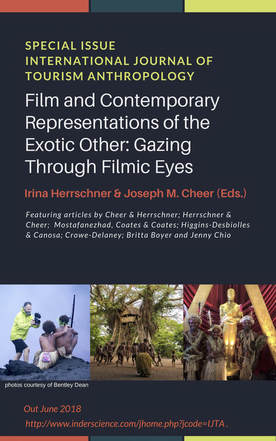 I was invited to write an afterword for this forthcoming special issue of the International Journal of Tourism Anthropology on film and the representation of "exotic others." The issue features a wide range of case studies of (mostly) documentary filmmaking projects across the Asia-Pacific region, and the authors analyze the multiple intersections between documentary film, tourism development, and the imagination of the other. Moreover, the essays in the issue question deeply how the representation of "otherness" is produced and practiced in touristic contexts.
In my afterword, I situate these case studies within broader anthropological debates on tourism imaginaries and visual anthropology. As my own work as an ethnographic filmmaker and anthropologist tries to show, the fundamental methodology of participation observation can and should be critiqued and challenged by concepts and practices of filmmaking and visual representation. Thus, I titled my afterword "filmmaking as critical participation observation" in order to illustrate what ethnographers (particularly those working in touristic contexts) can gain from taking film seriously in the practice and production of cultural representations. Click on the image for a list of articles and abstracts from the issue! 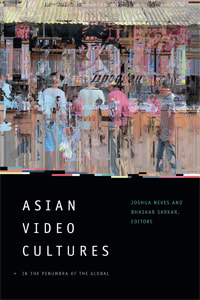 I have a new book chapter out in the edited volume, Asian Video Cultures (Neves and Sarkar, eds., Duke University Press, 2017). My contribution explores video documentary making in rural ethnic China, and I argue that these films and filmmakers are contributing to the rise of a distinctly rural public culture.
The volume explores a wide range of video-making across East, Southeast, and South Asia, and I'm thrilled to be a part of the book. The introduction to the volume is available to read and download online here: AVC Introduction. Two new essays of mine have been published in Critique of Anthropology, as part of a special issue I co-edited with Chris Vasantkumar exploring new anthropologies of rural society. My contributions examine architectural renderings of village residences as a constituent part of imagining rural modernity, as well as a short introductory essay on why it's (still) important for anthropology to think about and think through the idea of rurality as lived experience. The full issue [37(4)] is now online!
As part of the traveling exhibition, Quilts of Southwest China, I have been invited to give a public lecture and to screen my film at the Museum of International Folk Art in Santa Fe, New Mexico. This is a very exciting opportunity for me to connect my research on ethnic tourism and social change in rural China with the material culture practices and forms of knowledge transmission embodied in the region's embroidery and textile crafts. The film was also screened at the exhibition's first venue, in Indiana, earlier this year, but this time I'm grateful for the chance to engage directly with museum visitors and audiences. The public screening and lecture will take place on Sunday, October 8, 2017, and on the following Monday, I'll conduct a seminar on contemporary conditions in ethnic minority China for museum docents. It's really energizing to be able to connect my work with the museum community in Santa Fe, and conversely I look forward to learning a lot about the textiles and objects included in the show. 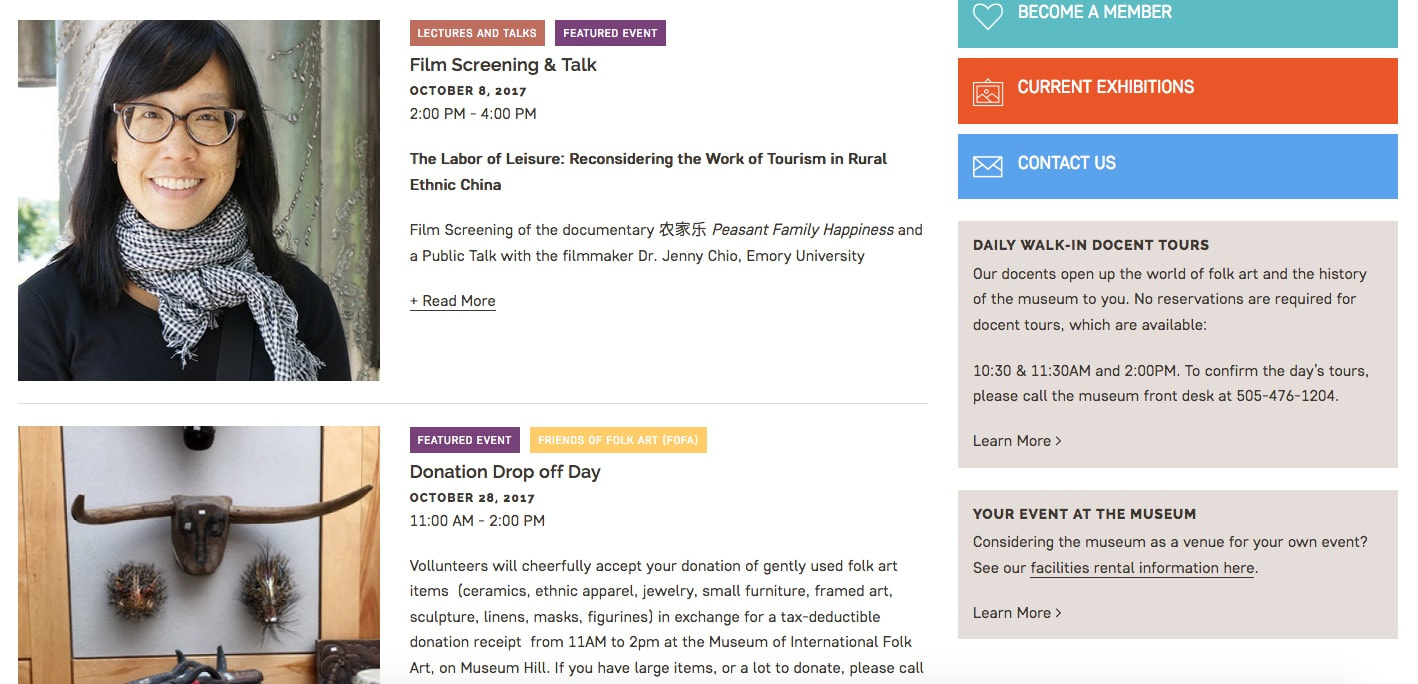 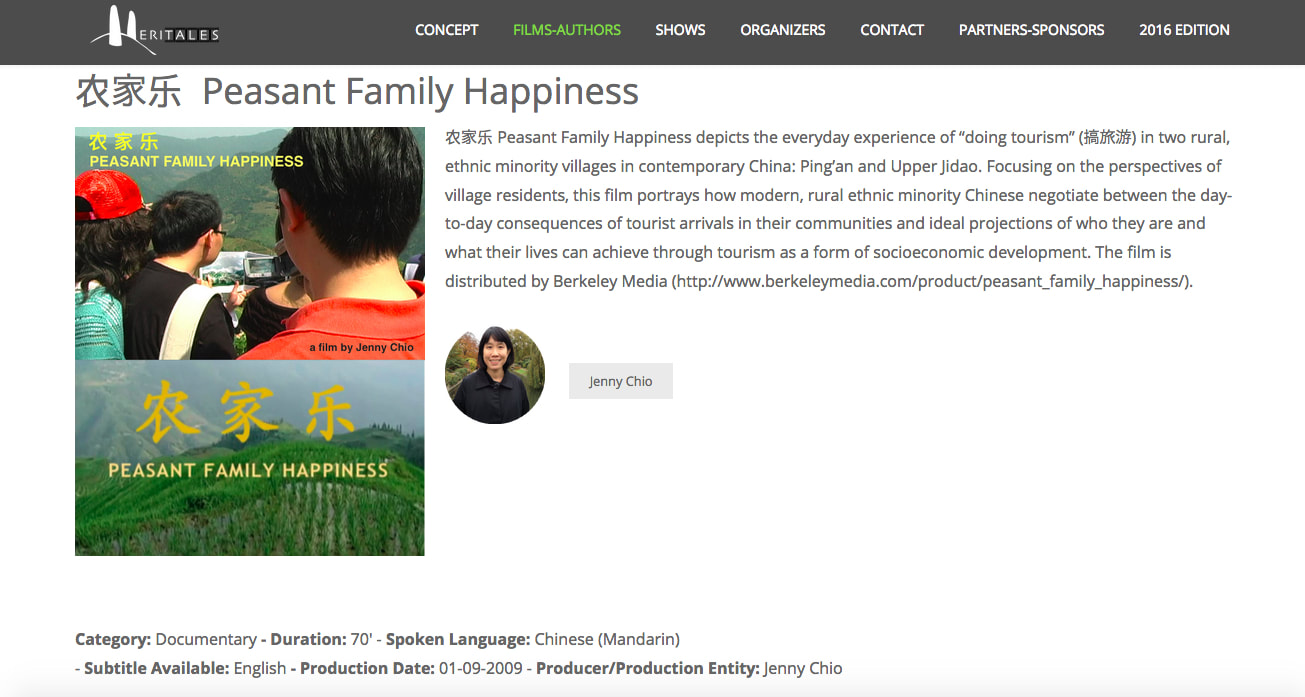 UPDATE 9/28/2017: My film was awarded an honorable mention in the medium-long length film category at the festival. I was very pleasantly surprised by this recognition, especially in the context of a festival devoted to exploring the politics of cultural heritage in the contemporary world.
农家乐 Peasant Family Happiness (2013) was selected for screening at the 2017 Heritales: International Heritage Film Festival in Évora, Portugal, which takes place September 21-23. This looks like an exciting festival that is coordinated by scholars at the University of Évora alongside support from UNESCO, and I'm really looking forward to attending the films and discussion. It's been really motivating for me to have folks in the cultural heritage and museum studies worlds interested in my work this year, particularly because the question of "heritage" is one that is opening a lot of necessary, and challenging, conversations about power, domination, and control. I think it's important to tackle these issues from multiple angles, so I'm glad to have this chance to share my work and think about different perspectives at the festival next month.
 |